
AI-Driven Smart Contract Development in Blockchain
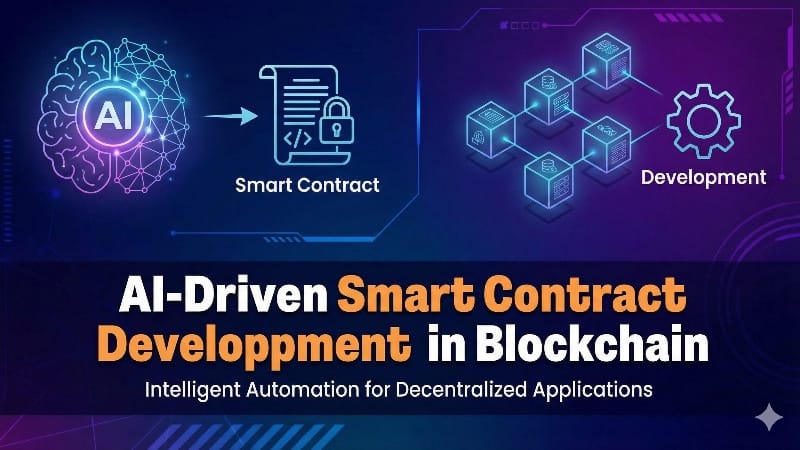
Smart contract development has advanced rapidly over the past decade, but the most transformative shift happening today is the integration of artificial intelligence into blockchain technology. As organizations increasingly adopt decentralized applications and trustless digital systems, AI is reshaping how smart contracts are built, optimized, and secured. The merging of AI and blockchain is creating a new generation of smart contracts that are more intelligent, more secure, and far more efficient than ever before.
Traditionally, smart contracts are self-executing programs written manually by developers. They bring automation, transparency, and immutability to blockchain systems. However, despite their benefits, manually written smart contracts can still suffer from human errors, code inefficiencies, and vulnerabilities that attackers can exploit. Since blockchain transactions are irreversible, even a single coding mistake can lead to substantial financial losses. This is where AI driven blockchain smart contract development is proving to be a game-changer. By leveraging machine learning, automation, and advanced data analysis, AI significantly reduces the risks associated with manual development.
One of the greatest advantages of AI in smart contract development is automated contract creation. Developers can now use AI powered tools to build contract templates, generate code snippets, and even write full functions based on user instructions. These tools analyze thousands of existing smart contracts to identify the best patterns, efficient coding standards, and secure logic structures. This not only speeds up the development process but also minimizes the chances of human error. Automated code generation ensures consistency, reduces development time, and improves the overall quality of smart contracts.
Security, one of the most crucial aspects of blockchain smart contract development, is also being transformed by AI. Smart contract vulnerabilities such as reentrancy, overflow/underflow, front-running, and logic flaws have historically caused major hacks, especially in DeFi and Web3 platforms. AI driven auditing tools use machine learning algorithms to detect suspicious code patterns, inconsistencies, and potential backdoors before contracts are deployed. These AI powered systems scan codebases much faster and more accurately than manual audits. Because they continuously learn from new exploits and attack trends, they offer an evolving layer of protection. This advanced security analysis significantly improves contract reliability and enhances user trust in decentralized applications.
AI also plays a major role in performance optimization. On blockchain networks, gas fees are typically calculated based on the computational intensity of a smart contract. Inefficient code results in higher transaction costs and slower execution, which affects both developers and users. AI optimization tools analyze smart contract logic and recommend more efficient structures, faster execution paths, and improved storage mechanisms. This reduces gas consumption, lowers operational costs, and boosts the scalability of decentralized applications. For large scale dApps, protocols, and blockchain enterprises, these optimizations translate into substantial long-term savings.
Another revolutionary contribution of AI to smart contract development is natural language processing (NLP). With NLP, developers and even non-technical users can write simple, plain language instructions that AI converts into executable smart contract code. This eliminates the barrier of understanding complex programming languages like Solidity, Rust, or Move. By making smart contract development more accessible, NLP opens the door for business owners, legal professionals, and project stakeholders to directly participate in contract design. This democratization of development empowers wider adoption of blockchain technology.
As multi-chain ecosystems expand, interoperability becomes increasingly important. Modern blockchain environments are no longer limited to Ethereum. Networks like Solana, Polygon, Aptos, Avalanche, and Binance Chain are widely used for various applications. AI systems can analyze differences between these blockchains and help ensure that smart contracts remain compatible across multiple networks. They can identify potential deployment issues, adjust code automatically, and maintain smooth cross-chain functionality. This seamless interoperability strengthens scalability and helps businesses reach broader user bases.
AI-driven governance is another emerging trend in decentralized systems. Many blockchain communities rely on DAOs (Decentralized Autonomous Organizations) to make decisions. AI tools can analyze voting patterns, detect unusual behaviors, and suggest improvements to governance structures. They help prevent manipulation, promote transparency, and create more resilient decision-making models. As DAOs continue to grow, AI will play an important role in maintaining fairness and efficiency.
Monitoring and maintenance are also enhanced through AI integration. After smart contracts are deployed, they must be continuously monitored for anomalies, performance degradation, or potential threats. Manual monitoring is slow and prone to oversight, but AI-powered systems can analyze real-time blockchain data, detect abnormal patterns, and alert developers instantly. This proactive approach helps prevent hacks, ensures stable performance, and extends the lifespan of blockchain applications.
Looking ahead, the relationship between AI and blockchain will grow even stronger. Developers are already experimenting with self-improving smart contracts that update themselves based on new data, autonomous financial systems that manage liquidity without human intervention, and AI-powered protocols capable of optimizing entire blockchain ecosystems. As both technologies continue to evolve, smart contract development will shift from manual coding to intelligent automation powered by AI assistants and self-learning systems.
In conclusion, AI is revolutionizing smart contract development by improving accuracy, security, efficiency, and accessibility. It automates code generation, enhances audits, optimizes performance, enables natural language coding, and improves cross chain functionality. As blockchain smart contract development continues to evolve, AI will play an increasingly critical role in shaping the next generation of decentralized applications and transforming how businesses build and maintain trustless digital systems.