

Smart School Management System for Digital Education
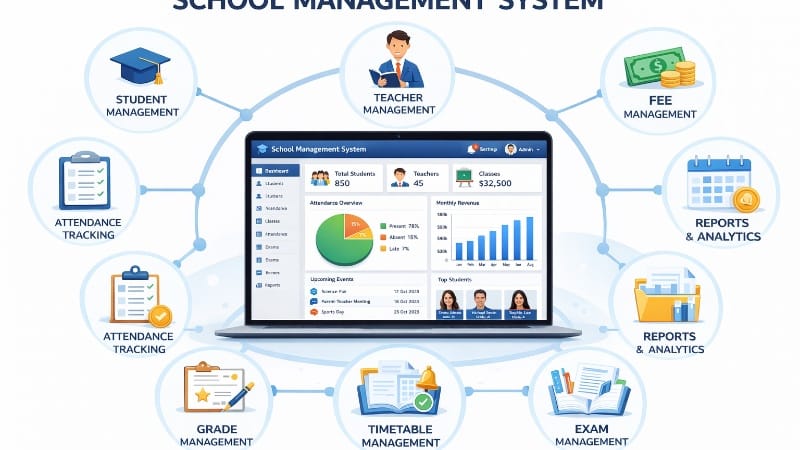
Technology, changing learning demands and increasing desire to have transparency and efficiency in the education sector are bringing about a fundamental transformation in the education sector. The hub of this change lies in the digital structure of school management, which is aimed at optimizing the work of academic and administrative processes and facilitating the use of modern teaching practices. Schools no more live in the times when they had to keep records manually or via computers, nowadays it is possible to use in-built systems that will unite students, teachers, parents, and administrators at any time.
A smarter school management system serves as the foundation of online education as it minimizes the complexity of operations and enables the institutions to concentrate on what really counts and that is student development, teaching and learning, and institutional performance.
What Is a Smart School Management System?
A smart school management system is a platform, which is centralized and digital and automatizes and controls daily school processes. As compared to simple software tools, the current systems are crafted in an adaptive, data-driven and easy to use way.
These systems are generally integrated to provide a single ecosystem with academic management, administrative processes, communication and performance analytics. Schools are getting uniformity, accuracy, and real-time interdepartment visibility by eliminating disconnected tools and paperwork.
Digital systems in enhancing institutional capacity and access to quality education have been repeatedly highlighted by educational technology organizations like UNESCO and World Bank as being key in such institutions to foster growth in their school environment, particularly in those experiencing rapid growth.
Why Digital Education Needs Smarter Systems
clasDigital education does not involve online lessons or smart boards. It also entails effective coordination, communication in time and making decisions using data. Without an effective system, well-equipped schools still find it difficult to come up with fragmented processes.
An intelligent management system allows:
Quick academic and administrative decision-making.
Greater monitoring of student progress.
Co-ordination among departments
Less reliance on human intervention.
These systems can be used as schools grow and enhance their consistency, accountability, and facilitate blended and digital learning models.
Core Features of a Smart School Management System
Academic Management and Student Records
A reliable system maintains complete student profiles, including attendance, grades, assessments, and behavioral records. Teachers can update data instantly, ensuring accuracy and continuity throughout the academic year.
Digital Attendance and Timetable Scheduling
Automated attendance tracking minimizes errors and saves valuablesroom time. Smart scheduling tools also help schools optimize class timetables, teacher workloads, and room utilization.
Communication and Parent Engagement
Effective communication is a defining feature of successful schools. Smart systems offer integrated messaging, notifications, and mobile access, helping parents stay informed about academic progress, announcements, and events.
Fees, Finance, and Administrative Automation
From fee collection to payroll management, automation improves financial transparency and compliance. Digital records reduce disputes and make audits significantly easier.
Analytics and Performance Insights
Data analytics allow school leaders to monitor trends, identify learning gaps, and plan interventions. Over time, this data supports informed policy decisions and measurable improvement.
Benefits for Schools, Teachers, and Parents
A smart school management system delivers value across the entire education ecosystem.
For schools, it reduces administrative workload and operational costs. For teachers, it simplifies classroom management and reporting tasks. Parents benefit from visibility and trust, knowing they can access accurate information without delays.
Supporting Digital Learning and Hybrid Education
As blended and hybrid learning models become more common, management systems play a critical supporting role. They ensure continuity between physical classrooms and digital platforms by synchronizing data, assignments, and assessments.
Smart systems also support learning management tools, online evaluations, and digital content distribution, helping schools adapt without disrupting academic flow.
Schoollog – A Practical Example of Smart School Management
Schoollog is one of the disruptive platforms in this category that is meant to address the practical requirements of the school in the present times. It is aimed at streamlining school functionality and providing tools that would aid digital learning without any complexity that is unnecessary.
Data Security and Compliance in School Systems
There is responsibility with more digitization. Data privacy of students and security of the system are very important issues to any institution. An intelligent school management system should be based on the established data protection requirements, employing secure servers, and the role-based access controls.
Schools and international data protection systems emphasize on the need to protect student data. Before applying any platform in schools, they are all supposed to review its security precautions.
Choosing the Right Smart School Management System
To appropriately pick the solution, one must do more than a feature comparison. The schools are supposed to take into consideration scalability, customer care, user-friendliness and long-term flexibility. A system must expand alongside the institution instead of inhibiting further development.
Involving teachers and administrative personnel in evaluation can result in improved adoption and success in the long-run.
Conclusion
A smart school management system has ceased to be an additional feature it is a prerequisite to digital education. These systems enhance efficiency, enhance communication, and aid the decision-making process based on data, which can help schools provide improved educational results in the rapidly changing world